DEAR COMRADES,
MANY OF US IN CONFUSSION THAT WHAT IS CADRE RESTRUCTURING IN POSTAL DEPARTMENT THE WORD WHICH WE HEAR FROM MANY SOURCES. TO MAKE YOUR SELF CLEAR ABOUT THE CONCEPT THE ENTIRE PROCEDURE IS COMPLIED AND PRESENTED HERE BELOW:
The Department of Personnel and Training, being the nodal Department for cadre review of all Group ‘A’ Central Services/Cadres, has issued various guidelines to facilitate the process. Cadre Review as a subject has been allocated to the Cadre Review Division, which also acts as the Secretariat for Cadre Review Committee constituted to review individual service/cadre. The cadre review proposals are scrutinised in this Division keeping in view the broad factors like functional requirements, stagnation at various levels, financial implications, measures for saving, organisational proficiency, etc . The proposals are then referred to the Department of Expenditure for financial concurrence and placed before the Cadre Review Committee for its approval. The Division also renders advice to the Cadre Controlling Authorities for better cadre management.
Cadre Re-Structuring - DoPT Circular
Subject: Review of Cadre structuring - Regarding.
3. All Ministries/Departments may give wide circulation to the contents of this O.M. for guidance and appropriate action in the matter.
2. As per decision taken in regard to item No 6,dealing with cadre restructuring of Group C employees,other than Accounts cadres, a committee comprising the following is constituted to examine the issue.
DDG(P)
Director (SPN)
Staff Side
Shri. K. V. Sridharan, GS, AIPEUG – ‘C’
Shri. Giri Raj Singh, GS, AIRMS & MMS EU Group ‘C’
Shri. D. Kishan Rao, GS, NAPE Gr. ‘C’
Shri. D. Theagarajan, General Secretary of National Union of RMS & MMS Group ‘C’ will attend the meetings of the Committee as an observer.
3. The Committee will submit its report within 3 months of its formation.
A separate identification to the extent of 30% of HSG I posts as non functional Group ‘B’ posts with grade pay of Rs. 4800/- will be formed.
The posts of System Administrators will be made as LSG vice versa.
IN SHORT CADRE REVIEW IS DONE FOR THE FUNCTIONAL REQUIREMENT OF ONE ORGANISATION.legitimate career expectations of its members to enhance the effectiveness of the service.
CRTSY: postmastermaharatsra blogspot
MANY OF US IN CONFUSSION THAT WHAT IS CADRE RESTRUCTURING IN POSTAL DEPARTMENT THE WORD WHICH WE HEAR FROM MANY SOURCES. TO MAKE YOUR SELF CLEAR ABOUT THE CONCEPT THE ENTIRE PROCEDURE IS COMPLIED AND PRESENTED HERE BELOW:
MINISTRY OF PERSONNEL, PUBLIC GRIEVANCES & PENSIONS
CADRE REVIEW
Cadre review is an important aspect of cadre management. It ensures a healthy balance between the functional requirements of an organisation and legitimate career aspirations of its officers. The thrust of such an exercise is on scientific manpower projection and recruitment planning in order to rationalise the cadre structure as also to enhance efficiency, morale and effectiveness of the service/cadre. In terms of the extant guidelines, ideal periodicity of cadre review is once ever y five years .
The status of Group ‘A’ Services is reviewed regularly. After first such review this year in April, all the concerned Departments were advised by the Cabinet Secretary to formulate appropriate cadre review proposals. Further, Para 1(ix) of the Government of India, Department of Expenditure Resolution No.1/1/2008-IC dated 29 August, 2008, whereby its decisions on the recommendations of 6th Central Pay Commission have been conveyed enjoins upon all the Cadre Controlling Authorities to review the services/cadres under the administrative control within a year. The Cadre Controlling Authorities have been reminded again October 2008.
There are 58 Central Group ‘A’ Services, out of which 44 services are due for cadre review this year, i.e., 2008. The cadre review proposals of five of the remaining forty four Group ‘A’ Services are already under active consideration. These are Indian
MINISTRY OF PERSONNEL, PUBLIC GRIEVANCES & PENSIONS
CADRE REVIEW
Defence Service of Engineers and Military Engineering Service (Surveyor Cadre), Military Engineering Service (Architect Cadre), Indian Inspection Service and Indian Supply Service The progress is being monitored constantly.
The Cadre Review Division also compiles and analyses statistical information of all the Central Group ‘A’ Services. The inconsistencies, if noted during the analysis, are brought to the notice of the concerned Cadre Controlling Authority. This exercise is undertaken on half yearly basis in January and July every year. The data as on 1st January, 2008 has already been compiled and analysed. The detailed report in this regard is also posted on this Department’s website. However, it has been decided that the next analysis would be done only after completion of cadre review of all the services envisaged in the Government’s Resolution mentioned above.
Objectives of a Cadre Review
3.3 The main purpose of a cadre review is to restructure a cadre in such a way as to remove the deficiencies which might be existing at the time of the constitution of a service or have crept in subsequently and ensure that the cadre structure satisfies the functional, structural and personnel considerations. Cadre review provides an opportunity to overcome various bottlenecks, remove existing distortions and bring about rationalisation of cadre structure so as to improve the efficiency and morale of the cadre officers and thereby enhance the effectiveness of the Service in the fulfilment of the objectives for which it has been established.
3.4 The major part of the cadre review exercise concerns advance projection of manpower requirements over the review period and the planning of recruitment for this period. Rationalisation of the cadre from the functional, structural and personnel angles is the other major objective of a cadre review. Specifically, the main objectives of cadre review are to:
i) estimate future manpower requirements on a scientific basis for a period of 5 years at a time,
ii) Plan recruitment in such a way as to avoid future promotional blocks and at the same time prevent gaps building up,
iii) so restructure the cadre as to harmonise the functional needs with the legitimate career expectations of its members and thus
iv) to enhance the effectiveness of the service.
3.5 The methodology of the cadre review is fully explained in the Detailed Guidelines (1978) appended to this Monograph (Appendix III). Salient features of the methodology are highlighted in the following link. Please click the link to see the details:
POINTS TO BE FOLLOWED BY THE CADRE CONTROLLING AUTHORITIES WHILE FORMULATING PROPOSALS FOR CADRE REVIEW
1. The proposal for cadre review may be formulated in accordance with the guidelines and instructions issued by the Department of Personnel and Training and Department of Expenditure. If there are any deviations, full justification therefore may be given.
2. The proposal should begin with a brief background of the Service and the development which have taken place since last cadre review.
3. It should contain the requisite data in prescribed proforma.
4. All contents may be chapterised suitably.
5. The abbreviations used in the proposal may be clubbed alphabetically in a list at the end of the proposal.
6. Full justification may be given individually for each upgradation/creation of posts, especially those at S.A.G. and higher levels.
7. While sending cadre review proposals to Department of Personnel & Training, the Cadre Controlling Authorities may indicate precisely the functional requirements of various categories of posts and group them in terms of duties and responsibilities. This can be done by conducting a general job evaluation exercise, which would help in ensuring that different grades in a cadre reflect distinctly different level of functions and that higher posts do have higher level of duties and responsibilities.
8. The existing level of stagnation vis-à-vis that after the proposed cadre review may be brought out clearly.
9. Various kinds of reserves may be shown separately (Training, Deputation, Probation, and Leave).
10. The existing training facilities and proposed augmentation, if any, may be indicated.
11. The existing strength and proposed strength (grade/pay-scale wise) may be given in a tabular statement.
12. Different mode of recruitment/promotion to various grades may be indicated.
13. All Instructions of the Government concerning downsizing the Government are duly taken into account.
14. Confirmation to the effect that the proposal will not result in any increase in the overall strength of the cadre or in introduction of new scales / grades.
15. Matching savings may be provided from within the cadre and financial implications of the proposal (which should be budget neutral) should be amplified.
16. If the posts in the lowest grade are proposed to be abolished, its effect, if any, on the promotion prospects of the incumbents of the feeder posts may be indicated.
17. While forwarding the cadre review proposals of Group ‘A’ Services, it may be ensured that cadre review of feeder posts from Group ‘B’, ‘C’ and ‘D’ be completed beforehand, so as to reflect the impact of the same on the induction into Group ‘A’ Services, whenever the same is envisaged in the Statutory Rules.
18. The position of a pending SIU Report, if any, may be stated. The concerned Ministry/Department should give a certificate that there is no ongoing SIU study having a bearing on posts covered in the Cadre Review Proposals and that no recommendations of SIU study pertaining to the cadre are pending implementation.
19. The position regarding applicability or otherwise of NFSG instructions to the Service may be brought out.
20. The status of the recommendations of the Sixth Central Pay Commission, if any, about the Service, may be given.
21. A copy each of the latest Civil List of the Service and the latest Service Rules (Recruitment Rules) together with all amendments may be enclosed.
In pursuance of the decision taken in the 2nd meeting of the National Anomaly Committee held on 27.03.2010, a Joint Committee to examine the anomalies pertaining to the Modified Assured Career Progression Scheme (MACPS) was constituted vide Department of Personnel & Training (D0PT)'s O.M. No.11/1/2010- JCA dated 03.05.2010.
The issue of providing an option to organisations/cadres to have a choice for the benefits under the earlier ACPS or the MACPS was also discussed in the meeting of the Joint Committee. While the issue would require further deliberations, it is re- iterated that MACPS (as was the case with the ACPS) is a fall back option in the event of promotions not taking place. Cadre structure needs to be reviewed periodically to harmonise the functional needs of the organisation and career progression of employees. Accordingly, all concerned are advised to review the cadre structure in a time bound manner with a view to mitigate problem of stagnation.
View the Order Below:
N0.35034/9/2010-Estt.(D)
Government of India
Ministry of Personnel, Public Grievances and Pensions
(Department of Personnel & Training)
iEstablishment (D)
Government of India
Ministry of Personnel, Public Grievances and Pensions
(Department of Personnel & Training)
iEstablishment (D)
North Block, New Delhi
Dated: 10th February, 2011
Dated: 10th February, 2011
OFFICE MEMORANDUM
Subject: Review of Cadre structuring - Regarding.
**********
In pursuance of the decision taken in the 2nd meeting of the National Anomaly Committee held on 27.03.2010, a Joint Committee to examine the anomalies pertaining to the Modified Assured Career Progression Scheme (MACPS) was constituted vide Department of Personnel & Training (D0PT)'s O.M. No.11/1/2010- JCA dated 03.05.2010.
2. The issue of providing an option to organisations / cadres to have a choice for the benefits under the earlier ACPS or the MACPS was also discussed in the meeting of the Joint Committee. While the issue would require further deliberations, it is re- iterated that MACPS (as was the case with the ACPS) is a fall back option in the event of promotions not taking place. Cadre structure needs to be reviewed periodically to harmonise the functional needs of the organisation and career progression of employees. Accordingly, all concerned are advised to review the cadre structure in a time bound manner with a view to mitigate problem of stagnation.
3. All Ministries/Departments may give wide circulation to the contents of this O.M. for guidance and appropriate action in the matter.
LAST CADRE RESTRUCTURING OF GROUP C EMPLOYESS OF DOP
Government of India
Ministry of Communications & IT
Department of Posts
Department of Posts
(SR Section)
Dak Bhawan Parliament Street
New Delhi – 110001
New Delhi – 110001
No. 1/4/2010-SR 6th August, 2010
Subject: - Secretary (P)’s meeting with Postal Joint Council of Action on 12.07.2010 – Item No. 6 – Cadre Restructuring of Group ‘C’ employees, other than Accounts Cadres – Constitution of a Committee.
This has reference to minutes of Secretary (P)’s meeting dated 12.07.2010 circulated vide No. 08/02/2010-SR dated 14.07.2010 on the above-mentioned subject.
2. As per decision taken in regard to item No 6,dealing with cadre restructuring of Group C employees,other than Accounts cadres, a committee comprising the following is constituted to examine the issue.
DDG (Estt)-
Charman
Official Side
DDG(P)
Director (SPN)
Staff Side
Shri. K. V. Sridharan, GS, AIPEUG – ‘C’
Shri. Giri Raj Singh, GS, AIRMS & MMS EU Group ‘C’
Shri. D. Kishan Rao, GS, NAPE Gr. ‘C’
Shri. D. Theagarajan, General Secretary of National Union of RMS & MMS Group ‘C’ will attend the meetings of the Committee as an observer.
3. The Committee will submit its report within 3 months of its formation.
Sd/-
(Subhash Chander)
Director (SR & Legal)
(Subhash Chander)
Director (SR & Legal)
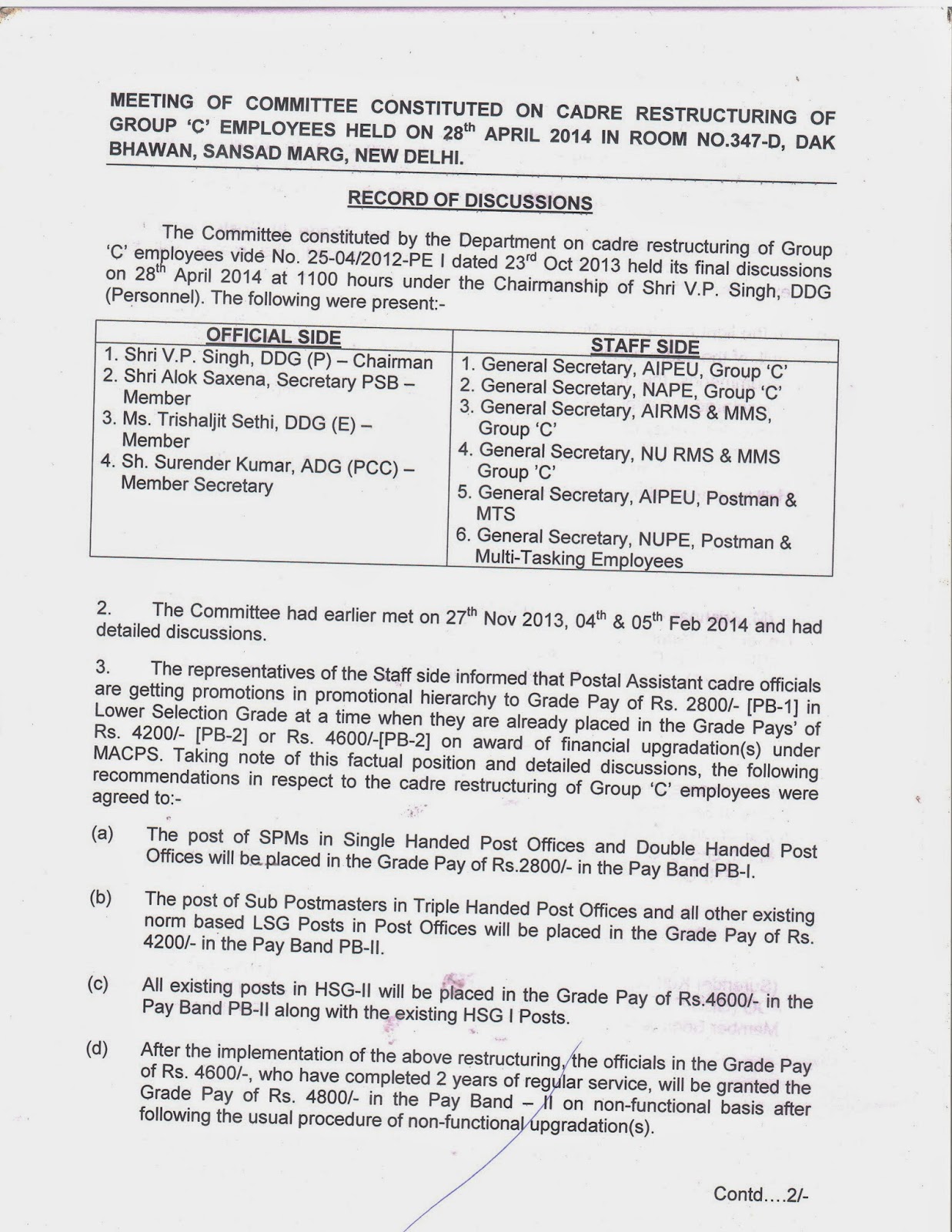
Cadre Restructuring Committee on 29.05.2012
The meeting was chaired by Dr. Saleem Haque, Chairman of the Committee and DDG (P), Shri Alok Saxena DDG (Tech), Director (Est), ADG (Est) were present on behalf of official side. Com. K. V. Sridharan, Leader Staff side, Com. D. Theagarajan, Secretary General, FNPO, Com. Giriraj Singh, General Secretary, R-III Com. Ishwar Singh Dabas, General Secretary, P4, Com. D. Kishan Rao, General Secretary, P 3, NAPE and T. N. Rahate, General Secretary, General Secretary, P4 FNPO were representing staff side.
The following are the broad understandings reached in the Committee meeting.
Postal Assistant
The proposal of the Staff side to upgrade 11395 single handed post offices and 6719 Double handed post offices to the status of LSG will be considered.
The present Post Masters in 3732 triple handed post offices and also the present LSG to the extent of 6989 will be upgraded to the status of HSG II.
The present Post Masters in 3732 triple handed post offices and also the present LSG to the extent of 6989 will be upgraded to the status of HSG II.
The present HSG II and HSG I posts to the extent of 3352 Posts will be amalagamated.
The RMS, Circle office and SBCO staff will be considered as per the ratio finalised in respect of Postal Assistant cadre.
The Official side accepted the above proposal and assured to consider the above and come out with the final decision shortly. As requested by them a common proposal of the Staff side has been submitted to day itself.
Cadre review for Postman & MTS’
the MTS is the common category for all Central Govt. employees, there is no possibility of bringing them under cadre review.
As functional Justification could not be identified for the Postman and also the higher pay granted by the 6th CPC, the official side did not favour any cadre review. However official side came forward with the proposal if the Postman cadre opts out from the MACP scheme and agree to take the percentage wise promotions it will be considered. It requires a deep study and the Postman unions will discuss the issue and come out with the proposals.
The chairman conveyed that the next meeting will be arranged in short notice to finalise the proposals.
source : aipeuchq
The chairman conveyed that the next meeting will be arranged in short notice to finalise the proposals.
source : aipeuchq
Constitution of Committee for Organizational Restructuring in the Department of Posts
With the approval of the Secretary a Committee for Organizational Restructuring in the Department of Posts has been constituted under the Chairmanship of Shri Ashutosh Tripathi, CPMG, Madhya Pradesh Circle. The Terms of Reference of the Committee are:
a) To revisit the norms for creation of new Postal Divisions and Regions as well as upgradation of Class II Division into Class I Divisions;
b) To study the feasibility of organizational restructuring of field formations (Circle and below) keeping in view the emerging needs for India Post in the new socio-economic environment;
c) Review of norms for upgradation of Post offices;
d) To study the feasibility of strengthening / creation of Postal Assistants /Sorting Assistants Posts in view of the increased need of Systems Administrators;
e) Any other relevant issue as may be assigned by the Competent Authority later.
2. The Committee is at present examining the feasibility of Organizational Restructuring of field formations (Circle and below) keeping in view the emerging needs for India Post in the new socio-economic environment as well as induction of technology in the Department. While deliberating on this, the Committee has decided to obtain valuable inputs from the concerned stakeholders.
3. In the light of the above, the Directorate has now requested the CPMsG to provide their considered views on what, according to them are the problems (both administrative and operational) in the current Organizational set up and what could be the possible revised structure for all category of Offices that could address these problems with the given human & financial resources.
4. They have also been requested to give their views on possibility of creation of Vertical Silos clearly identifying the possible Silos given the nature of the work in the Department of Posts not only as per the current scenario but also the possible one in the next decade; along with their possible structures; responsibility, financial; and reporting system etc. The possibility of extending the Silos till the Head Post Office may also be considered.
CRTSY: postmastermaharatsra blogspot